
Timber Decking in Sheffield — Supplied & Fitted
Pressure treated softwood and hardwood decking, designed and installed across Sheffield and South Yorkshire, typically £100–£150 per square metre fitted for standard softwood. We are installers rather than a board merchant — we build the sub‑frame, the steps and the edge detail, and we re‑treat every cut end. Send photos and rough measurements for a provisional quote.
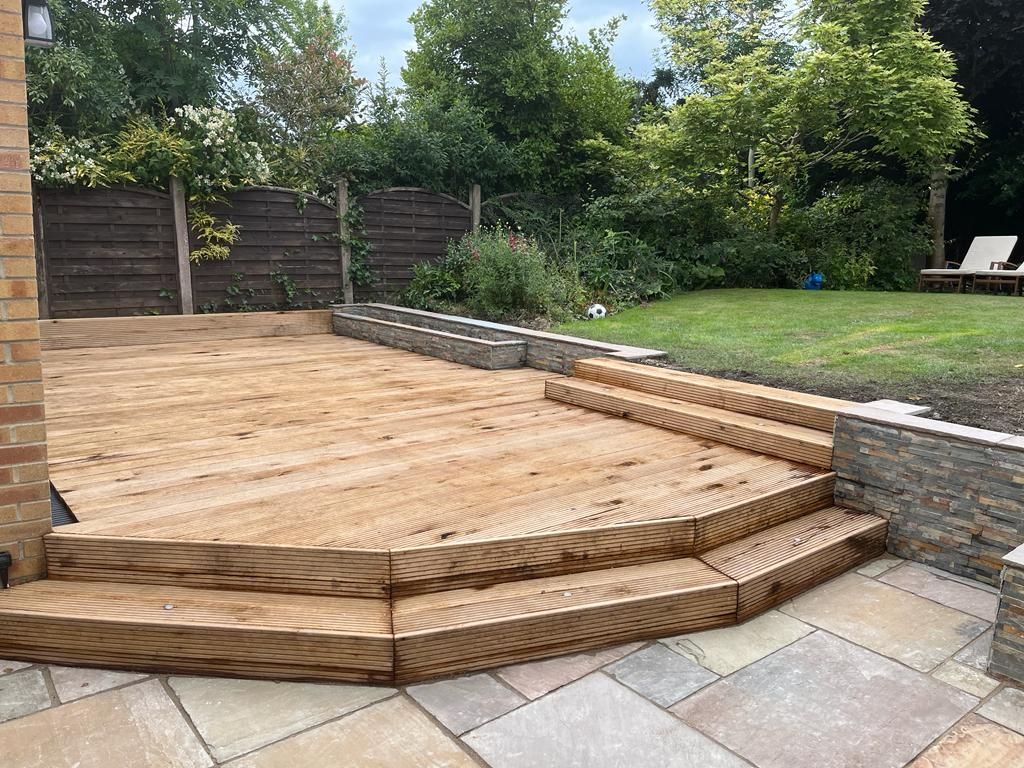
Timber decking built across Sheffield
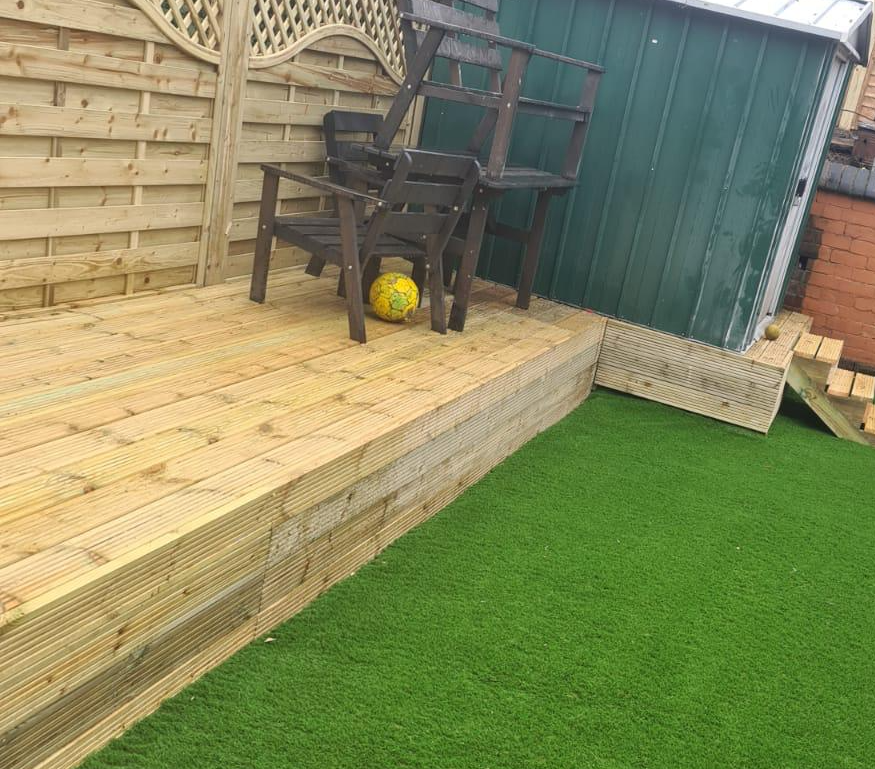
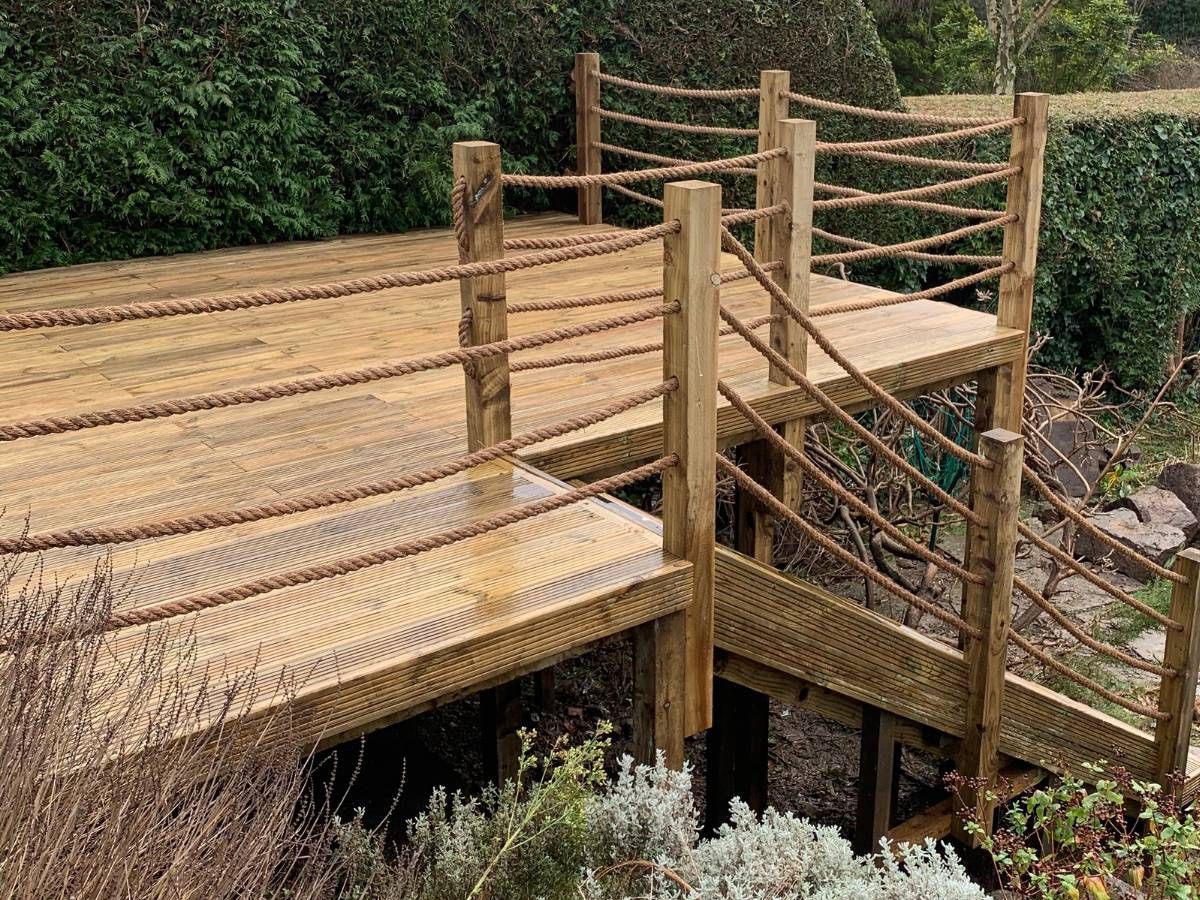
Pressure treated softwood and hardwood, from a simple platform to a raised deck with steps and balustrades. Four recent installations from around Sheffield and South Yorkshire.

Softwood or Hardwood?
Almost every timber decking decision comes down to this one, and the honest answer is that most Sheffield gardens get softwood — for good reasons rather than cheap ones.
Softwood — the usual choice
Pine and spruce, pressure treated before it ever reaches your garden. Typically £100–£150 per square metre fitted, easy to work, and around fifteen years of life if it is looked after.
Hardwood — the long game
Slow grown broadleaf timber. Considerably more expensive to buy and slower to install, and it needs far less treating because it resists rot and insects naturally.
How they age
Softwood greys off without oiling and loses its shine in high traffic areas. Hardwood darkens over time and, for most people, improves as it does.
Where softwood struggles
Permanently damp, shaded gardens and heavy footfall. If that is your plot, it is worth talking about hardwood or composite decking before committing.
Slip resistant boards
Less well known, but timber boards are available with an inset strip of grit or rubber for grip. Worth considering on steps in particular, where most slips actually happen.
Steps, edges and balustrades
Matching timber steps, fascia detail and spindle balustrades, all built at the same time so the deck reads as one piece of work.
What Pressure Treatment Does — and Where It Stops
This is the part of a timber deck that decides whether it lasts fifteen years or eight, and it is almost never discussed at quote stage.
Pressure treatment forces preservative into the timber under pressure, which is why treated softwood survives outdoors at all. What people assume is that the treatment goes all the way through. In most treated softwood it does not — it penetrates the outer zone of the board and leaves the heart of the timber largely untreated.
Which matters enormously, because every time a board or joist is cut, that cut face is raw, untreated timber. On a deck there are a great many cuts: every joist end, every board end, every notch around a post. If those faces go down as they are, water gets into the timber at exactly the points where the frame carries the most load.
We brush end grain preservative onto every cut face before it is fixed. It takes time on site, it is invisible in the finished deck, and it is one of the clearest differences between a deck that is still solid in year twelve and one that is soft at the joist ends in year seven. If you are comparing quotes, it is a fair question to ask each of them.
The related point is ground contact. Timber specified for use above ground is not the same as timber specified for contact with soil, and posts going into the ground need the right grade. A frame built from the wrong specification will fail from the bottom regardless of how well the surface is maintained.
The Maintenance, Honestly
Timber decking is the cheaper option to install and the more demanding one to own. It is worth going in with clear expectations rather than discovering them in year three.
Expect to oil or stain it every two to three years. That is the single thing that decides whether softwood reaches fifteen years or gives up at eight. It is not difficult work — a dry weekend, a brush and a decent decking oil — but it does have to happen, and nobody does it for you.
Sheffield gardens are hard on timber. We are wet, we are green, and a great many decks here sit in shade for part of the day. Moss and algae build up faster than people expect, particularly on north facing plots and anything under trees. Autumn leaf fall left to rot on the surface is the worst offender, because it holds moisture against the boards all winter and feeds exactly the growth that makes a deck slippery.
A once a year scrub, clearing leaves rather than letting them sit, and keeping the gaps between boards clear so water drains through will do most of the work. Check fixings occasionally too — a screw or nail that has started to lift is easily dealt with and becomes a trip hazard if it is left.
If none of that appeals, that is a legitimate reason to look at composite instead, and we would rather tell you now than sell you a deck you will resent.
What Affects the Cost
Timber grade. Standard treated softwood at the bottom, better graded softwood in the middle, hardwood substantially above both.
Ground conditions. Flat and firm is straightforward. Sloping or soft ground needs more frame and more labour.
Height off the ground. Raised decks need a heavier frame, steps and balustrades, all of which add to the figure.
Shape. Squares and rectangles cut efficiently. Angles, curves and cut‑outs around trees generate waste and time.
Access. Materials that wheel straight in cost less to install than materials carried through a house.
Removing an old deck. Taking up and disposing of an existing deck is chargeable work and worth pricing separately.
Get a Provisional Timber Decking Quote
Send a couple of photos of the area and rough measurements. We can usually come back with a provisional figure within 24 hours, without needing to visit first.
Timber Decking Questions
How long can I expect timber decking to last?
Maintenance decides it more than the timber does. A softwood deck treated with a quality decking oil or stain every two to three years will typically give around fifteen years. Left untreated, expect considerably less. Hardwood lasts longer and costs more up front.
When should I replace my timber decking?
Widening gaps between boards, boards that move underfoot, or a balustrade with give in it are the visible signs. Lift a board and check the frame. If the joists are soft it needs full replacement; if they are sound, new surface boards alone will do.
Do you supply deck boards without fitting them?
No. We are a supply and fit installer rather than a board merchant, so materials only come as part of an installation we carry out. That way the sub-frame, fixings, cut end treatment and edge detail are all our responsibility rather than yours.
Do you treat the cut ends of the timber?
Yes, every one. Pressure treatment does not penetrate all the way through a board, so each cut exposes untreated timber. We brush end grain preservative onto every cut face before fixing. It is invisible in the finished deck and it is what stops joist ends rotting early.
Is timber decking slippery when wet?
It can be, though algae causes it far more than the timber does. Keeping the deck washed and clearing leaves makes the biggest difference. Boards with an inset grit or rubber strip are also available, and are worth considering on steps in particular.
How does timber compare to composite on cost?
Timber is roughly £100 to £150 per square metre fitted against £150 to £250 for composite. Over fifteen years the gap narrows once you count the oil, the weekends and any boards replaced. Timber wins on price; composite wins on time.
Do I need planning permission for timber decking?
Usually not, if the platform sits no more than 300mm above ground level and covers no more than half the garden. Raised decks on Sheffield's sloping plots often exceed that. Guarding is required separately where the drop from the edge is more than 600mm.
Decking fitters across Sheffield and South Yorkshire
We work throughout Sheffield and the surrounding villages. If your area is not listed, get in touch anyway — we almost certainly cover it.